
Are Residential Decarbonization Renovations worth the Investment?
ASHRAE's Center of Excellence for Building Decarbonization website defines building decarbonization as “methods that reduce human-made GHG [Greenhouse Gas] emissions related to buildings.” These GHG or carbon emissions of buildings are made up of both building operations carbon emissions - primarily the use of energy to heat, cool, light and otherwise power buildings. They also represent the embodied carbon inherent in the building construction, use and end-of-life (from raw materials extraction, transport, installation, through the building use and demolition, deconstruction, recycling or landfill disposal.)
Whenever decarbonization-focused renovations of existing buildings are considered, a question is undoubtedly posed (sometimes earlier, sometimes later in the process): Is demolition of poor-performing buildings and replacement with new construction a more worthwhile investment? The financial term “ROI” is occasionally raised and applied to buildings and other built environments, while less readily measurable values are ignored. Values such as the social and emotional capital of families remaining in their homes, or the pride of maintaining a stable home for someone formerly unhoused, are challenging to monetize and are, consequently, disregarded in a return-on-investment calculation. The reader could insert any number of anecdotal housing stories here, which would further enrich the context surrounding the question of housing value.
However complex the question of value, Residential Property Owners are nonetheless charged with making reasonable and informed decisions regarding continued or capital investments in their properties. Those decisions must be made year after year. For Affordable Housing and Public Housing Owners, especially during times of uncertain funding and market volatility, these decisions require Owners to have expansive and deep Operations and Maintenance knowledge, to weigh MANY factors, and, in this writer’s opinion, to display great courage. Why courage? Because Owners rightly continue to protect their property investments in the face of uncertainty, and because the answer to the question, “Is investing in Decarbonization of an Existing Building worth it?” is almost always, annoyingly, “yes, however….” This is how companies like ZeroEnergy Design end up doing decarbonization feasibility studies and why we continue to advocate for custom and project-specific design solutions. The truthful and inconvenient response to whether it’s worth saving existing buildings is yes, however the amount of reasonable investment depends on any number of factors.
One factor is the building’s use. We want to focus on residential buildings, in particular Affordable Housing and public housing, a dedicated focus of ZeroEnergy Design, because (1) Community Resilience depends first and foremost on people having access to safe and healthy shelter, (2) As a state, region, and nation, we are currently experiencing a housing crisis (1) where many already do not have secure or affordable housing (meaning affordable to a vast array of incomes), and (3) Climate change is raising the threat of residential displacement across the country due to coastal or riverine flooding, increased precipitation, or wildlands and urban/suburban fires. Add to the equation the ethical imperative to provide equitable and decent housing for individuals who are low-income, under-housed, or historically marginalized, and renovations of federal- or state-funded and maintained properties become all the more critical. In our opinion, the immense societal and resiliency NEED for stable and healthy residential buildings, especially at this point in time, increases the value of investing in “decarb retrofits” of this particular building type.
The value of any renovation also depends on other factors:
The condition of the existing buildings and their systems, including whether they have been maintained or have extensive deferred maintenance;
The necessity of preserving prior investments or other property assets, such as accessible unit conversions, window replacements, or hazardous material remediation (which may have required capital campaigns in the recent past);
The suitability of the originally-designed building for its current and future use. Adaptive reuse aside, think how much smaller homes and room interiors were in the new construction of post-WWII America, or how sprawling, many-roomed Victorian homes were, compared with contemporary homes, which usually center a kitchen / family room reflecting today’s lifestyles;
Location and Site Context - How will construction sequencing, staging, and logistics be implemented? Are the required utilities available at the site, or must infrastructure be developed and utility service be brought to the site? How do municipal regulations affect the project costs?
Soft costs other than design, such as permitting, community outreach, and resident relocation costs;
Whether the existing use and scale are the best long-term use for the property. With the high cost of both renovations and new construction, the team should consider whether the property could reasonably be redeveloped with increased density, thereby furthering the Owner’s mission to house more people.
These evaluations are important calculations for Owners to make prior to undertaking a major renovation.
Unless conducting a renovation by replacing “in-kind” (meaning replacing existing building systems to the original performance specification at the time of installation), our experience of retrofitting existing residential buildings in Massachusetts is that building costs are often, but not always, comparable to ground-up construction. Due to the older building stock found in the Northeast, replacing “in-kind” may include obsolete or substandard materials and systems, which do not represent professional best practices and are not recommended. In-kind replacement may no longer be an acceptable, healthy, safe or code-compliant solution.
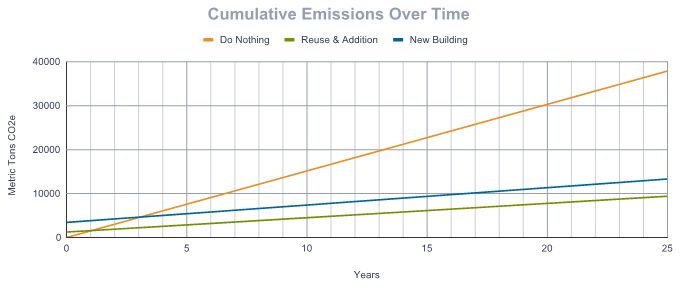
While the value of decarbonization retrofits of existing buildings has broad support across the high-performance design and construction community, the question of how extensive an intervention to make is hotly debated and evolving among professionals (see Byggmeister’s “Our Evolving Approach to Energy Retrofits”). Some practitioners advocate for abandoning or demolishing poor-performing buildings, some advocate for all existing buildings to be brought up to current new construction standards (this would represent best practice for the long-term continued use of the property), and some advocate for a “good enough” approach (fixing only certain aspects of the construction). Our professional opinion falls primarily in the second camp when the budget allows, with concessions considered acceptable where necessary for not doing the maximum intervention to meet project goals and budgets. The crux of the argument for renovation over new construction is that the embodied carbon of existing structures, as well as the embodied carbon of new structures/materials, can significantly increase or reduce GHG emissions generated by a project. Therefore, we generally advocate for decarbonization retrofits as a means of reducing construction and operational emissions.
In a New Construction project or renovation with a healthy budget, our approach is (1) to invest maximally in a well-detailed, highly-insulated envelope, (2) to install right-sized, efficient and balanced mechanical systems, and (3) to offset site energy use with renewable energy systems - generally Photovoltaics for their market availability and pricepoint.
In a Decarbonization Retrofit on a limited budget, our approach is more nuanced: we advocate for maximum emissions reductions within the project budget, without introducing unreasonable amounts of embodied carbon. Taking into account unique or special project considerations, the project priorities are developed based on the Owner’s or Community’s goals, and seek to identify and avoid any intervention which might result in diminishing returns. We also prioritize preserving and prolonging the life of the building(s) to the greatest extent possible. All-electric operations, or strategic electrification/decoupling from fossil fuel, is our first priority for any renovation, for both environmental and human health and safety reasons. We endeavor to further inform the Owner by outlining the costs of intervention as well as the known and unknown costs of inaction. Using the established project priorities and our quality-focused standard practice, we develop a custom approach for each project.
The costs of intervention are the sum of hard and soft costs typically associated with a design and construction project, as well as the inconvenience to the residents and the property owner.
The costs of inaction include environmental degradation and economic inefficiency; most of us can think of examples where deferred maintenance or repairs led to higher costs later. There are also quantifiable social equity impacts. The housing shortage can be exacerbated if existing buildings are not maintained and become untenable for human habitation. The State Strategic Housing Plan notes the state’s public housing system has an estimated $4 billion backlog of capital improvements; additionally, 6,000 units of privately-owned affordable housing are at risk of conversion to market rate before 2027 (2). These statistics help explain why Protecting Existing Homes and Affordability is the second of five strategies in the State’s Strategic Housing Plan (3). When routine maintenance is deferred year after year, eventually buildings and their systems fail and limited funds must be spent on repairs rather than capital investment. This complicates both the financing and construction logistics of renovations, making decarbonization investments even more challenging. Every public housing development we have studied or for which we proposed an intervention has some deferred maintenance in a variety of areas and to differing degrees.
In a recent decarb feasibility study for a large 1950 masonry family development, we identified a significant economic benefit of renovation over new construction using the Carbon Avoided Retrofit Estimator (4) (CARE) Tool. In the same study, another cost of inaction we monetized was construction cost escalation. Sadly, many projects remain unfunded or underfunded because they are too expensive now, yet the cost increases at the next funding cycle, and again the next.
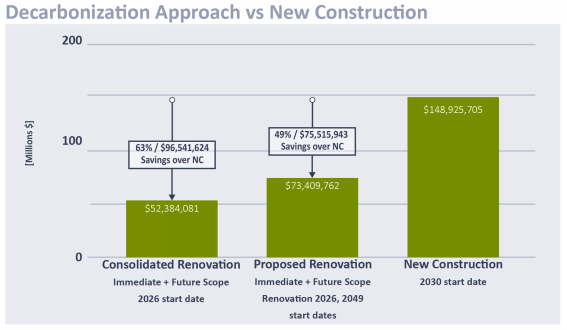
There are MANY more existing homes than new being built at any point in time in our communities. This fact should tell us that preserving housing in healthy, well-functioning order should be the priority for owners, government leaders, and industry practitioners. Today’s decent, healthy, well-functioning housing must produce minimal emissions if they are to continue to meet human needs into the future. Therefore, we encourage owners of low income and affordable housing to prioritize the social, emotional, and health benefits that decarbonization renovations provide residents and the wider community when they calculate the benefits versus costs of continued property investment.
Footnotes:
1) Refer to “Executive Summary: Understanding and Tackling Massachusett’s Housing Challenge” from A Home for Everyone (February, 2025) for an overview of this complex problem, available at https://www.mass.gov/doc/a-home-for-everyone/download
2) Refer to p. 20 of A Home for Everyone (February, 2025), available at https://www.mass.gov/doc/a-home-for-everyone/download
3) Refer to p. 29-31 of A Home for Everyone.
4) The CARE Tool is an open source tool for the building sector used for estimating and comparing the embodied, operating, and avoided carbon impacts and benefits of reusing and upgrading existing buildings or replacing them with new construction. It is an Architecture 2030 project, developed by Larry Strain of Siegel & Strain Architects, Lori Feriss of Goody Clancy, and Erin McDade of Architecture 2030, with input from the Zero Net Carbon Collaboration, the Climate Heritage Network, the Carbon Leadership Forum, and Epic, among others.