Renovating a Cape Cod Home: Comfort, Character, and Performance
The traditional New England Cape house is one of the region’s most enduring architectural typologies. Defined by its steep roof pitch, compact massing, restrained overhangs, and cedar shingles, it evolved as a pragmatic response to the coastal climate and available building methods of its time. But these homes were also constructed long before modern insulation standards, high-performance windows, and balanced ventilation systems existed.
Many Cape homeowners think they just have to deal with the upstairs bedroom that is too cold to use by December, the oil bills that arrive every few weeks, and the drafts that come in no matter how many times they are addressed. For those considering a Cape renovation, these issues often feel like permanent tradeoffs rather than solvable performance problems.
Stephanie Horowitz, a high-performance architect who has designed homes on the Cape for over two decades, points out that the same compact form and minimal overhangs that make an old Cape drafty also make it an unusually strong candidate for transformation. "The traditional Cape Cod plan lends itself to the efficiencies of super-insulated homes," she explains. "The short or absent overhangs allow us to wrap a house with continuous insulation. In other styles, longer overhangs can create a thermal bridge at a notoriously weak point where the roof meets the wall. Not so with a Cape."
Cape Cod home renovations are an opportunity most homeowners only get once. This post covers what goes into doing them well.

Cape home by ZeroEnergy Design in Chatham Massachusetts
What Most Cape Cod Renovation Plans Miss
Most Cape renovations focus on the visible parts of the house: a new kitchen, a more open floor plan, or a dormer addition to create usable space upstairs. While these improvements can transform how a home looks and functions, they often leave untouched the systems that determine how the house actually performs day to day. One of the most important parts of that is the building envelope: the walls, roof, foundation, windows, and the air barrier that ties them together.
Most Cape Cod homes built before 1980 have minimal wall insulation, if any. The knee walls in the half-story, which are the short vertical walls between the floor and the sloped ceiling, are almost never properly insulated or air-sealed. Single-pane windows lose heat in every direction, and the heating system, usually oil-fired, works overtime to compensate for all of it.
A renovation is often the best opportunity to address these issues comprehensively. Once the walls are closed and finishes are complete, many of those decisions become effectively locked in for decades. The approach that addresses all of it together is called a deep energy retrofit. This treats the building envelope as a system, reducing energy demand dramatically before right-sizing the mechanical systems to match. The result can be a 75 to 90 percent reduction in heating and cooling energy.
On the Cape, the stakes are higher than in most places. The coastal environment brings humidity above 60 percent for much of the year, salt air accelerates deterioration in conventional materials, and nor'easters expose every weakness in the envelope. A renovation that addresses performance is also a renovation that addresses durability and resilience.
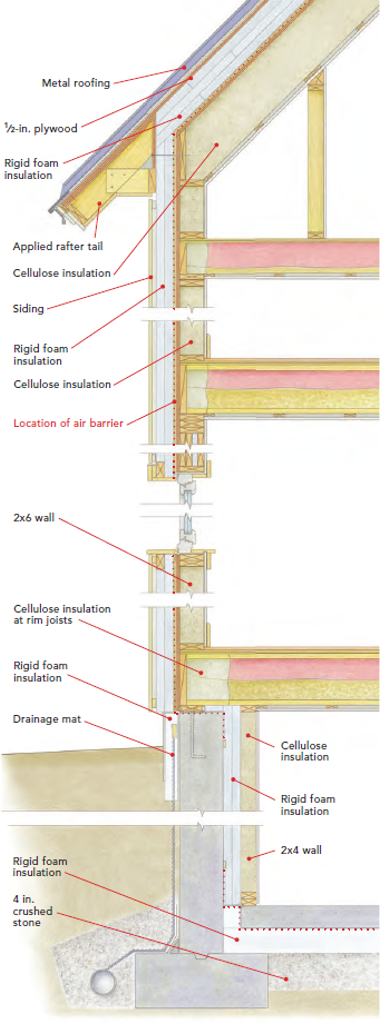
Typical Envelope detail
Cape Cod Home Renovation Ideas That Perform as Good as They Look
The most successful Cape Cod home renovation ideas are the ones where the performance work and the aesthetic work happen at the same time. Here is how that plays out across the decisions that matter most.
Dormer Additions
The dormer is one of the most defining Cape Cod additions and the one with the most thermal complexity. A typical pre-renovation Cape has a half-story that is essentially outside the thermal envelope. The knee wall cavity connects to unconditioned attic space, the sloped ceiling has little or no insulation, and the space is cold in winter and unbearable in summer.
A dormer addition, whether a shed dormer or a Nantucket dormer, is the moment to fix all of this. The roof plane gets properly insulated as part of the construction, the knee wall is eliminated or fully air-sealed, and triple-pane windows are installed throughout. When it is done this way, the result is not just more headroom but a room that is genuinely comfortable year-round.
Opening the Floor Plan
Removing walls to open the living space is one of the most common Cape renovation ideas, and it’s also the right moment to reconsider the mechanical system. If the envelope is being improved as part of the renovation, the old heating system is now oversized for the actual load. Redesigning the mechanical system at the same time means sizing cold-climate heat pumps correctly and incorporating an energy recovery ventilator, or ERV, which provides controlled fresh air to every room. Planning for it during a renovation is straightforward. Retrofitting it into a finished space is considerably more difficult.
Windows and Daylighting
Windows are where most Cape homeowners feel the performance gap most directly: cold glass, condensation, and the chill that makes sitting near a window in January unpleasant. Triple-pane windows keep the interior glass surface warm even when it is well below freezing outside, which means window seats become usable spaces and glazed areas can be larger without energy penalty.
For properties in the Old King's Highway Regional Historic District, which covers land north of Route 6 from Sandwich through Orleans and is the largest historic district in the United States, window replacement requires careful attention. Modern casement or fixed windows may not be approved. The solution is triple-pane windows with simulated divided lites that replicate the muntin pattern of traditional double-hung windows. They look right from the street and perform at a level the originals never could.
Electrifying the Mechanicals
Most Cape Cod homes still heat with oil. Replacing that system with cold-climate heat pumps, sized correctly to the improved envelope, eliminates fossil fuel combustion on site and runs quietly because the envelope is doing most of the work. A heat-pump water heater replaces the old tank and the ERV handles ventilation. One thing worth understanding: the size of the mechanical system shrinks as the quality of the envelope improves, which is why right-sizing after envelope improvements are designed matters.
Considering a renovation on the Cape? ZeroEnergy Design works with homeowners across the peninsula, from Sandwich to Provincetown. Tell us about your project →
What Makes Cape Cod Renovations Different
Renovating a Cape Cod home means working within a set of climatic, regulatory, and construction conditions that are distinct to the region. Understanding them before the project begins changes what gets designed and how.
Salt Air and Coastal Exposure
Within a mile of the coast, salt aerosol corrodes conventional steel fasteners, flashing, and HVAC equipment. Marine-grade stainless steel fasteners, coastal-rated HVAC units, and rainscreen cladding that allows moisture to drain and dry rather than trap behind the siding are standard practice on the Cape, not optional upgrades.
The Old King's Highway Historic District
This protected district covers portions of six towns from Sandwich through Orleans. Any exterior change visible from a public way requires a Certificate of Appropriateness, including adding exterior insulation, replacing windows, and in some cases solar panel placement. Exterior insulation can be detailed to maintain historic proportions, and triple-pane windows with simulated divided lites pass review routinely. Working with an architect who has presented projects to these committees before matters, because high-performance construction methods need to be explained in terms the committee can understand, and then evaluate.
FEMA Flood Zones and the Substantial Improvement Rule
Many Cape properties sit in FEMA-designated flood zones. If the cost of a renovation equals or exceeds 50 percent of the building's pre-improvement market value, the entire structure must be brought into full compliance to current flood codes. For a home valued at $900,000 in Chatham, that threshold is $450,000, which a major renovation will often reach. It should be assessed before the project is scoped, not after the budget is set.
Humidity and Seasonal Vacancy
The Cape sits above 60 percent relative humidity for much of the year. Homes that sit closed through the shoulder seasons are particularly vulnerable to mold in wall cavities and crawlspaces. A proper ventilation strategy, including an ERV and in some cases supplemental dehumidification, is part of designing a Cape renovation correctly rather than an afterthought.
What to Look for When Hiring an Architect for a Cape Cod Renovation
A Cape Cod renovation that addresses the building envelope, the mechanical systems, the historic district requirements, and the coastal environment at the same time is a coordination challenge. Decisions made early in the design process about the roof assembly, the window strategy, the ventilation approach, determine what is possible later. This is the core reason for working with an architect who understands building science, not just design.
A Certified Passive House Consultant brings energy modeling to the process, meaning the performance of the renovation can be simulated before construction begins. WUFI hygrothermal analysis models how moisture moves through wall and roof assemblies over time, which is particularly relevant on the Cape where humidity and temperature swings can cause condensation problems. Blower-door testing at the end of construction verifies that airtightness targets were actually achieved.
ZeroEnergy Design's most recent Cape Cod projects are new construction, but the envelope performance they demonstrate is directly relevant to what a deep energy retrofit can achieve. The Chatham Marshview House reached an EUI of 0.5 kBtu per square foot per year and 0.3 ACH50, which is 99 percent better than code requires. The Wellfleet Modern House reached an EUI of 5.0 and 0.27 ACH50. These numbers reflect what careful envelope design, executed precisely through construction, produces on Cape Cod.

Coastal Cape Cod home in Orleans, Massachusetts
Explore ZeroEnergy Design's Cape Cod portfolio: the Chatham Marshview House and the Wellfleet Modern House
A House Built for New England
The Cape Cod house form is 400 years old. It was designed for this climate, with a compact footprint, steep roof, and minimal overhangs that shed snow and rain and hold heat. Those same qualities make it one of the better candidates for high-performance renovation in the modern era.
A well-renovated Cape is warm upstairs in January, quiet during a nor'easter, the air stays fresh without opening a window. There are no oil deliveries and the upstairs bedroom that was unusable in August is now the best room in the house. This is not a vision of what is possible someday. It is what thoughtful Cape Cod home renovations are producing right now, in towns across the peninsula.
If you are planning a renovation on the Cape and want to understand what that process looks like, we are glad to talk through it.
Planning a Cape Cod renovation? Let's talk about what's possible →